Open for pre-order · first kits ship December 1, 2026

Annual BDA inspections and pre‑installation surveys,
from fieldwork to report.

Qualified ERCES/BDA contractors measure P25 and analog FM coverage, record the equipment checks, and leave the site with the signed inspection report—one offline Android workflow and a receiver calibrated per serial and per band.

  • P25 and analog FM
  • VHF · UHF · 700 · 800 MHz
  • Serial-tracked calibration
  • PDF reports · Word (image pages)

$4,995 plus tax and shipping · Pre-orders ship December 1, 2026; orders placed after November 15 ship within 4 weeks · Optional $1,295/yr Assurance Renewal after year one — not charged today

Release 1.0Offline field workflow

Release 1.0Customer portal

In serviceProduction calibration bench

Fast Radio Survey field kit: a rugged Android tablet running a coverage survey, connected by USB-C to the serialized SDR receiver with its antenna

Kit shown as a production-design render with a demo project on a fictional floor plan; the exact kit configuration is confirmed on your order acknowledgment.

Designed for qualified field teams
ERCES / BDA integrators
Radio service teams
Low-voltage contractors
Independent RF testers
Two jobs, one kit

Built around the recurring job.

Most ERCES field days are either an inspection visit to an installed system or a coverage survey before one goes in. The kit is organized around those two jobs, not around a spectrum display.

Primary use case

Annual BDA inspections

Return to the existing building project, start a new survey visit, capture the RF measurements the inspection plan calls for, and document the equipment checks. Battery-test readings, donor-antenna observations, alarm and supervisory checks, photos, remarks, and signatures come together in one organized inspection report.

How the inspection visit works
Second use case

Pre-installation coverage surveys

Document existing radio coverage before a BDA is designed or installed. Import the floor plans, define grids and critical locations, collect calibrated measurements, and share clear findings for project planning and AHJ review.

How the survey loop works
Annual inspection visit

More than a signal reading. An organized record of the inspection visit.

The ERCES inspection form in the app follows the sections of a standard public-safety BDA/DAS test report. RF evidence comes from the kit; equipment checks are entered by the technician on the same tablet.

  1. 01
    The app's survey screen on the demonstration building: a graded floor-plan grid with the floor, channel, and survey-visit selectors

    Open the building project

    Reuse the floor plans, grids, critical points, and channels from the original project; add a new survey visit for this year's measurements. Several inspections live under one project, typically one per year.

  2. 02
    Recertification section of the inspection form: item 15a answered from survey results, listing the failed grid area and the count of locations not tested

    Capture the RF evidence

    Measure the locations the inspection plan requires with the calibrated receiver. The grid and critical-area items (15a/15c) can be filled from the tested locations, with every failed location named and every untested location counted—never hidden.

  3. 03
    Batteries and secondary power section of the inspection form with load-test answer, battery temperatures, and voltages

    Document the system checks

    Record battery load-test results for the head end and each fiber remote, donor-antenna values at commissioning versus today, active-component and isolation checks, alarm and supervisory signals, and deficiencies—with photos attached to the visit.

  4. 04
    Sign-off section of the inspection form: the building representative's drawn signature, name, date, and the remarks and deficiency field

    Prepare the inspection report

    Collect technician and building-representative signatures on the tablet, add remarks and recommendations, and generate the PDF with the grid results, survey notes, and photo appendices for owner and AHJ review.

Sample report page: battery temperature and voltage tables for the head end and two fiber remote amplifiers, followed by alarm-panel monitoring checks
Equipment checks: batteries, remotes, alarm monitoring
Sample report page: the graded floor plan for the inspection visit with one failed area highlighted and per-area results
RF results: graded plan and per-location table
Sample report page: technician and building-representative signatures with the remarks, deficiency, and recommendation text
Findings, deficiency, and signatures
Download the sample inspection report (PDF) 12 pages · fictional building and data · generated by the app

What the kit does, and what it does not. Fast Radio Survey combines supported RF measurements with technician-entered inspection records. Battery load testing, physical inspections of antennas and enclosures, isolation and uplink tests, and other required procedures use the appropriate external equipment; the app records their results. Inspection scope and accepted methods remain subject to the applicable requirements and the AHJ. Year-to-year comparison is by the visit records kept in the project and the commissioning-versus-current table; the app does not compute historical deltas. The measurement limits described in the specifications and FAQ apply to inspection visits as they do to surveys.

Pre-installation coverage survey

Document coverage before the BDA goes in.

The survey loop keeps the whole job on one tablet: prepare the plan, collect valid point measurements, review status, and produce the report while the site is still in front of you. The same loop records the RF evidence on an inspection visit.

Fast Radio Survey app on a tablet: a completed 122-sample capture on a grid cell over a graded floor-plan grid, showing calibrated RSSI, S/N, FBER, derived DAQ, the detected P25 modulation, and a live channel spectrum DEMO DATA
Actual interface captured on tablet hardware with a live, calibrated receiver on a real P25 control channel; the floor plan and the other readings are demonstration data.
  1. 01

    Bring in the plan

    Import an image, selected PDF pages, or floor-plan imagery from a compatible iBwave .ibwc export (beta). Calibrate scale on the tablet.

  2. 02

    Lay out the survey

    Draw and divide test grids, mark critical points, select the P25 or analog FM channel—or a group of control channels measured in one pass—and set project-specific thresholds.

  3. 03

    Collect with context

    Capture RSSI, adjacent-spectrum S/N, frame-sync FBER, and a derived DAQ estimate. Add comments, dictated notes, and photos.

  4. 04

    Report before you leave

    Review project-configured pass/fail status, preview annotated reports, and share them as PDF or Word (image-based pages) from the tablet.

Built for a survey crew—not a lab bench

The field essentials, in one offline workflow.

Fast Radio Survey is intentionally focused on the repeatable P25 and analog FM downlink work that fills the day—on VHF, UHF, 700 and 800 MHz—annual inspection visits where the local method permits, pre-installation surveys, optimization, punch lists, troubleshooting, and internal QA.

01

Offline by design

Field collection and report generation stay on the Android tablet. A building’s dead zone does not become a workflow dead end.

02

Project-aware grading

Configure thresholds for area and critical points, then re-grade existing readings when project criteria change.

03

Evidence stays attached

Keep readings, locations, comments, photos, survey visits, and inspection records with the building project that produced them—this year's visit next to last year's.

04

Spectrum view when needed

Use the swept analyzer and waterfall as an indicative troubleshooting aid, with markers, presets, RBW/VBW, and report snapshots.

05

Strong neighbours handled, not hidden

When a nearby carrier is holding the receiver’s gain down, the capture screen says “Strong nearby signal” and tags the readings taken under it. You can capture only between an intermittent neighbour’s transmissions, or let the app name the carriers it sees and try the receiver’s IF window—kept only when the measured S/N improves. Every such reading carries its tag into the report, so the record shows how it was taken.

Spectrum AnalyzerINDICATIVE
Built-in spectrum analyzer scanning the 850 to 870 MHz band: live and max-hold traces over dozens of carriers with a marker readout and waterfall
800 DLRBW AUTOMAX HOLD
Generated Grid Test report page: a passing floor with a graded plan overlay, 19 of 20 area points and 3 of 3 critical points passed, and the per-point results table DEMO REPORT
A practical position

More capable than a spot check.
More focused than an enterprise platform.

Premium scanner platforms remain the right tool for broad multi-technology validation and formal workflows that demand them. Fast Radio Survey is built as the accessible, every-crew tool for inspection visits and focused P25 survey work.

Deliver annual BDA inspection visits where the local method permits Survey coverage before a BDA is designed Pre-test a floor before commissioning Optimize and close a punch list Troubleshoot a coverage complaint Add a second or backup survey kit
Transparent by design

What ships December 1, stated plainly.

Release 1.0 covers the field workflow and the customer portal; the automated production-calibration bench is in service. Every receiver is calibrated per serial and per band on that bench, and no receiver ships until its serial has passed it. DMR and LTE Band 14 are in development and are listed as such, not sold.

Release 1.0

Android field workflow

  • Projects, plans, grids, and critical points
  • P25 and analog FM channel measurements on VHF 150–174, UHF 450–512 (incl. T-band), 700 MHz 764–776, and 800 MHz 851–869
  • P25 Phase 1 (C4FM and CQPSK/LSM) field capture and grading, including Phase 2 system control channels
  • Strong-neighbour handling: floor-limited tag, gap capture, interferer identification with an IF-window trial; NAC and frame-type decode
  • In development: DMR and FirstNet LTE Band 14 (RSRP, PCI, SINR)—delivered to kits with active assurance as each completes validation
  • Notes, photos, multiple survey visits and inspections per building project
  • ERCES inspection report (checklist, donor and battery tables, drawn signatures, grid / notes / photo appendices), grid test, and notes reports with PDF / Word sharing
  • Indicative spectrum analyzer and captures
In service

Production calibration

  • Automated bench: modulated P25 reference signal, two-stage attenuation, Signal Hound SA44B reference analyzer
  • Every receiver calibrated per serial, per band (VHF, UHF, 700, 800 MHz) across all 15 field tuner gains
  • Blind-validated against withheld conducted levels; expanded uncertainty about ±1.5 dB (k = 2)
  • Signed profile applied in the field; readings outside its scope are flagged, never silently corrected
Release 1.0

Customer portal

  • Activation-code licensing with offline entitlements
  • Signed per-serial calibration profiles
  • Evidence and test-package uploads with history
  • Offline field work remains independent
Our portal principle

Your tablet does the job on site. The cloud adds continuity; it does not become a field dependency.

Is it the right instrument for the job?

Where the kit fits, what you still bring, and when to escalate.

The kit is a focused P25 and analog FM downlink instrument with a calibrated 8-bit receiver. The specifications below disclose its limits in full; this is what they mean on a job.

Suitable work

Recurring inspection and survey visits

  • Annual BDA inspection visits where the local method permits: the RF evidence, the equipment-check record, and the signed report
  • Pre-installation surveys and pre-commissioning floor tests on P25 and analog FM downlinks
  • Optimization, punch lists, coverage complaints, and internal QA
  • A pre-installation survey often sits at the weak-signal edge where the receiver's strong-neighbour limits apply; a reading tagged "floor-ltd" is a lower bound there, not a design figure
You still bring

The method and the non-RF tests

  • The test method, documentation standard, and AHJ coordination for the jurisdiction
  • Battery load testing, physical inspection, and isolation or uplink tests with their own equipment; the inspection form records the results
  • A technician qualified to judge the readings; the tool does not decide whether a BDA is required
Not measured

Outside release 1.0

  • True co-channel SINR, full-channel payload BER, and audio decode
  • DMR and FirstNet LTE Band 14 (in development, not sold)
  • Trunking follow or system identification from the NAC; interferer location or direction finding
  • Year-over-year comparison, carry-forward of last year's answers, and completeness validation of the inspection record
When to escalate

Use a scanner-grade platform instead

  • Formal acceptance workflows and broad multi-technology validation that demand one
  • Sites with strong neighbouring channels where 20 dB S/N must be shown on signals weaker than about −88 dBm: measure with a scanner-grade receiver rather than lowering the project criterion
  • Any reading the app has tagged "floor-ltd" that a design or acceptance decision would rest on
Verified against the app

Technical specifications you can hold us to.

Every figure below is release 1.0 as it ships—measurement scope, supported hardware, formats, and default grading—verified against the app before publication.

Measurements

RSSI
Channel-integrated; corrected by the receiver's signed per-band calibration profile, conducted bench-validated expanded uncertainty about ±1.5 dB (k = 2). Valid down to about 6 dB above the noise floor; closer to the floor a reading should be read as “at or below”. An uncalibrated RTL-SDR reads 3–11 dB high depending on tuner gain
Bands
VHF 150–174 · UHF 450–512 incl. T-band · 700 MHz 764–776 · 800 MHz 851–869 (P25 and analog FM)
S/N
Adjacent-spectrum estimate against the receiver's own noise floor (not co-channel SINR). Within 1–2 dB of a scanner-grade receiver on strong signals; 10–18 dB lower on weak signals at sites with strong neighbouring channels. 20 dB S/N is readable down to about −103 dBm on a clean site and about −88 dBm on a loaded site
Noise floor
Set by the strongest carriers within 2.4 MHz of the channel (8-bit receiver). About −123 dBm per 12.5 kHz on a clean site, −118 dBm typical, −108 dBm where neighbouring channels sit 20 dB or more above the measured channel (measured on two live 800 MHz control channels). S/N is reported against this floor
Strong neighbours
Readings taken while a nearby carrier holds the gain down are tagged “floor-ltd” (S/N is a lower bound; the grade is unchanged). Gap capture measures only between an intermittent neighbour’s transmissions, at the gain the channel deserves alone (“gap”). After a minute under the banner the app names the carriers it sees—frequency, level against the channel, duty cycle, unmodulated or modulated—and can try the tuner’s one-sided IF window for a carrier more than 650 kHz away; the window is kept only if S/N improves by 3 dB or more (“if-cut”). None of this lowers the receiver’s own noise floor; FBER and DAQ are unaffected
FBER
P25 Phase 1 frame-sync error rate (C4FM and CQPSK/LSM simulcast, auto-detected); no voice decode. Phase 2 traffic channels report RSSI and S/N
NAC
Decoded per reading from the P25 Phase 1 Network ID together with the frame type (control or voice) and printed in the report’s channel table; a blank channel NAC is filled from the air and a configured NAC that disagrees with the air is flagged. Not trunking follow or system identification
DAQ
Derived from FBER via editable table; DAQ 3.4 = 2.6% BER per TIA TSB-88.1E
Capture
122 readings ≈ 10 s per point (default)

Receiver hardware

Receiver
RTL-SDR (RTL2832U + R820T/R820T2) over USB OTG
Reference unit
Nooelec NESDR SMArt v5, 0.5 ppm TCXO
Tuning range
24–1766 MHz
Sampling
2.4 MS/s, 8-bit I/Q
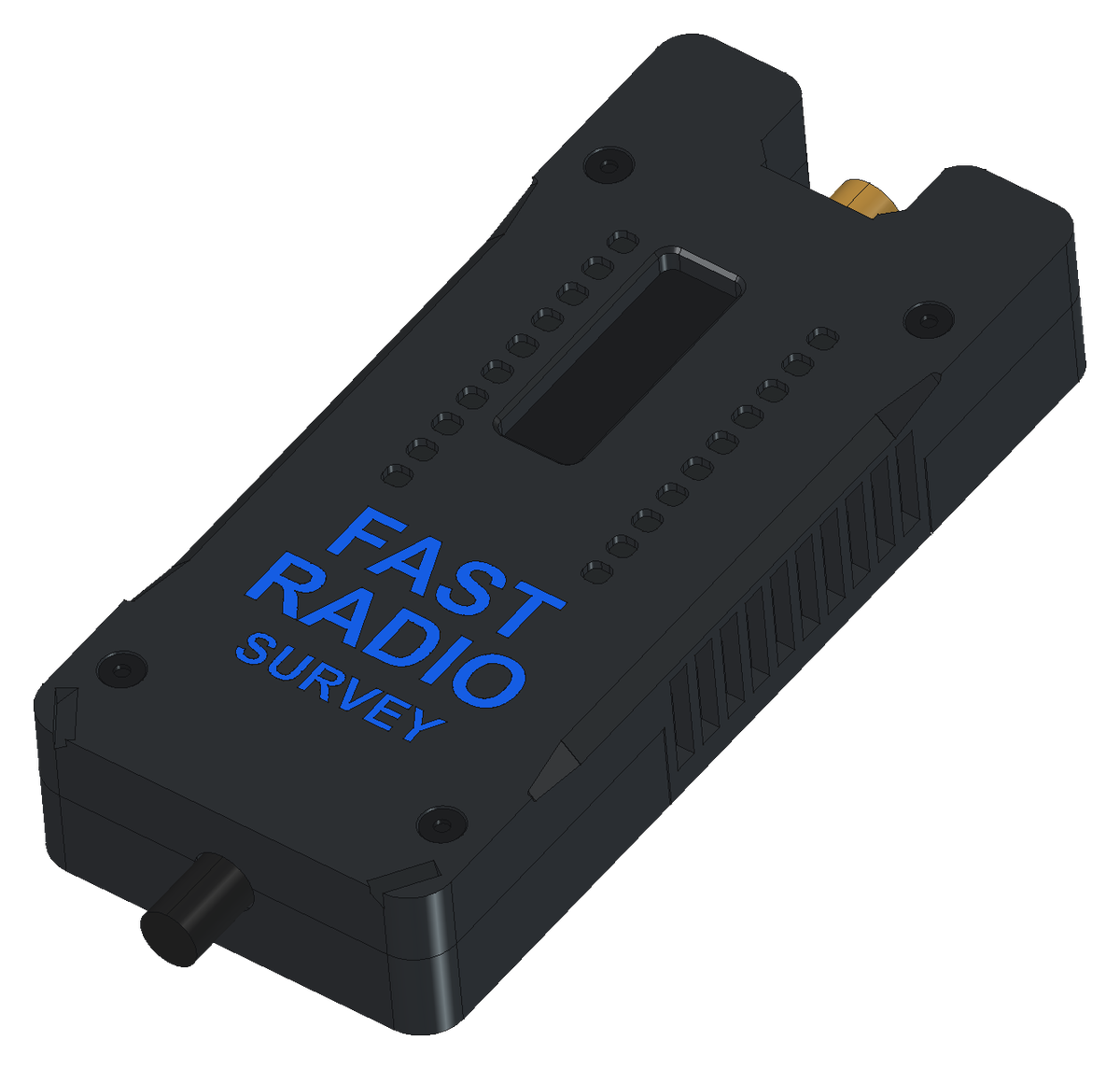
The receiver enclosure: dark charcoal housing with the Fast Radio Survey logo, status LED row, vent grille, SMA antenna input, and USB port

P25 support scope

Supported
P25 Phase 1 frame-sync BER on C4FM and CQPSK/LSM simulcast downlinks—modulation auto-detected, measured without decoding the full channel—including the control channels of Phase 2 TDMA systems; NAC and frame type decoded from the Network ID. Analog FM channels: calibrated RSSI and S/N (no FBER/DAQ)
In development
DMR and FirstNet LTE Band 14 (RSRP, PCI, SINR)—delivered to kits with active assurance as each completes validation
Not included
P25 Phase 2 (TDMA) traffic-channel FBER; Phase 2 traffic channels report RSSI and S/N
Also not included
Voice decode, trunking follow, full-channel payload BER

Spectrum analyzer Indicative · survey aid only

Band presets
800 DL 851–869 · 800 UL 806–824 · 700 DL 757–777 · T-band 481–501 · UHF 450–470 · VHF 150–160 · VHF 160–174 MHz
Span
50 kHz – 20 MHz
Controls
Markers, max-hold, RBW/VBW, presets, report snapshots

Thresholds & grading Configurable · 95%/99% coverage defaults align with IFC 510 and NFPA 1225

RSSI
−95 dBm (product default; edition- and jurisdiction-dependent)
S/N
20 dB area / 22 dB critical (product default)
FBER
2.0% area / 1.5% critical (product default)
DAQ
3.0 area (recognized minimum in NFPA 1225) / 3.4 critical (product default)
Pass rate
95% of area points / 99% of critical points

The 95% general-area and 99% critical-area coverage values align with the model-code criteria in 2024 IFC §510.4.1 and 2022 NFPA 1225 §§18.8.3–18.8.4. The adopted code edition, local amendments, test methods, and AHJ-approved project requirements control. S/N is measured against this receiver's own noise floor: on sites with strong neighbouring channels the 20 dB default is reachable only above about −88 dBm RSSI, so plan the test method with that in mind rather than lowering the criterion.

Floor-plan import

Formats
Images · PDF (up to 300 dpi, multi-page picker) · iBwave .ibwc (beta)
.ibwc scope
Beta, pending iBwave approval; plan images, pre-calibrated scale, transmitter placements
Source
Standard Android document picker; no cloud dependency

Reports & export

Report types
ERCES Inspection (form, signatures, appendices) · Grid Test · Yearly Inspection (grid test plus notes) · Notes
Formats
PDF generated on-device; Word .docx with image-based pages
Snapshots
PNG analyzer captures via the share sheet

Inspection records

Form
Follows a 2026 public-safety ERCES (BDA) and DAS system test report template: building and system information, testing company and technician, test equipment and calibration dates, pre-test and record-keeping items, active-component checks, recertification items 15a–15d, batteries and secondary power, alarm monitoring, final checks, sign-off
Donor antenna
Nine specification rows recorded at commissioning and at the current test (type, gain, coordinates, azimuth, uplink and downlink gain, donor signal, donor site, channelized/broadband) plus BDA temperature; the ±2 dB / ±5° checks are answered by the technician
Batteries
Load-test answer, temperature and voltage per battery (four at the head end) and per fiber remote amplifier; values are recorded, not judged against a limit
From survey results
Items 15a and 15c filled from tested locations against the project's own thresholds; failed locations named, untested locations counted
Sign-off
Technician and building-representative signatures drawn on the tablet; remarks, deficiency, and recommendation text
Not yet
Jurisdiction-specific form templates, carry-forward of last year's answers, and automatic year-over-year comparison of readings

Platform

Android
8.0 or newer (targets Android 15)
Hardware
USB host (OTG) required; tablet-optimized layouts
Connectivity
Field collection, grading, and reports work fully offline; Internet is used only for activation and optional portal sync

RSSI is corrected by the receiver's signed calibration profile for the band and tuner gain in use; a reading outside that scope is flagged and reported as uncalibrated rather than silently corrected. Specifications describe the current release; the exact production kit configuration is confirmed on your order acknowledgment.

First production batch

Put one calibrated inspection and survey kit on every crew that needs one.

Buy a complete kit outright from the first production batch. Each receiver ships only after its serial passes the production calibration process—that is why there is a stated lead time, not a waitlist.

No surprise charges. $4,995 plus tax and shipping today; nothing else is charged automatically.

No forced cloud dependency. Core field collection and reporting remain offline-first.

No implied approval. Acceptance methods remain subject to project requirements and the AHJ.

Fast Radio Survey Field Kit
$4,995 per kit

Complete first-production kit. Plus tax and shipping.

What ships in the kit

The serialized SDR receiver included in the field kit
  • Samsung Galaxy Tab S10 Lite tablet, imaged and verified with the receiver
  • Serialized RTL-SDR receiver (NESDR SMArt v5 class, 0.5 ppm TCXO) cleared through production calibration
  • Standardized antenna, cables, adapters, and field case
  • Offline Fast Radio Survey app and onboarding
  • First-year updates, support, warranty, and customer-portal access

Each receiver ships only after its serial passes the production calibration process. Pre-orders ship December 1, 2026; orders placed after November 15 ship within 4 weeks of order. Optional Assurance Renewal after year one: $1,295 per active kit/year; not enrolled or charged at purchase.

Straight answers

Before you buy.

Questions about fit, timing, fleet quantities, or using your own tablet? Email us.

Is Fast Radio Survey production-ready?

The Android field workflow, the customer-portal backend—activation-code licensing, signed calibration profiles, and evidence uploads—and the automated production-calibration bench are built and in service. Each receiver is calibrated per serial and per band, and no receiver ships until its serial passes it. That is part of the stated lead time.

Can I use it for annual BDA inspections?

Yes, for the RF evidence and the inspection record. The kit measures the locations the inspection plan calls for, and the ERCES inspection form in the app records the equipment checks—batteries, donor antenna, active components, alarm monitoring—along with photos, remarks, and signatures, then generates the report. Battery load tests, physical inspections, and isolation or uplink tests are performed with the appropriate external equipment and procedures; the app records their results. Whether the kit's measurements are accepted for a given inspection depends on the applicable requirements and the AHJ.

Does it compare this year's readings with last year's?

Not automatically. Each visit's readings are kept as a separate survey under the building project, and the inspection form carries a commissioning-versus-current table for the donor antenna, so the history is there to review. The app does not yet compute year-over-year deltas or carry last year's answers into a new inspection.

Is this a replacement for a PCTEL scanner system?

No. Fast Radio Survey is a focused complement for qualified teams doing annual inspection visits where the local method permits, pre-installation surveys, P25 downlink pre-tests, optimization, punch-list work, troubleshooting, and internal QA. Broad multi-technology and formal acceptance workflows may still call for a premium scanner platform. The practical measurement difference is sensitivity: the kit's 8-bit receiver has a higher noise floor on sites with strong neighbouring channels, so its S/N reads lower than a scanner's on weak signals there; RSSI, FBER, and DAQ are unaffected. The app flags those readings, can measure between an intermittent neighbour’s transmissions, and names the carrier responsible so the fix can be found at the source.

What does the current P25 workflow measure?

On VHF, UHF (including T-band), 700 and 800 MHz, the app reports calibrated channel-integrated RSSI, an adjacent-spectrum S/N estimate, P25 Phase 1 frame-sync FBER (C4FM or CQPSK/LSM simulcast, detected automatically), and a derived DAQ estimate; analog FM channels report RSSI and S/N. That covers Phase 1 systems and the control channels of Phase 2 TDMA systems; Phase 2 traffic channels report RSSI and S/N only. It does not claim true co-channel SINR, full-channel payload BER, or audio decode. S/N is reported against the kit's own noise floor, so on weak signals at sites with strong neighbouring channels it reads lower than a scanner-grade receiver would; FBER and DAQ are unaffected until S/N falls below roughly 8–10 dB. It also decodes the NAC and frame type from the P25 Network ID, so the record shows which system was measured and whether the channel was carrying control or voice frames.

Does a report guarantee AHJ acceptance?

No. Requirements and permitted methods vary by jurisdiction and project. Qualified users remain responsible for the test method, equipment choice, documentation, and AHJ coordination.

When will my kit ship?

First production kits ship December 1, 2026. Orders placed after November 15 ship within 4 weeks of order. Your order acknowledgment states the ship window; if we cannot meet it, you may accept the delay or cancel for a full refund.

Can I cancel my order?

Yes. You may cancel for a full refund to the original payment method any time before your kit ships. After delivery, returns are handled under the purchase terms and warranty.

Can I use my own tablet?

A receiver kit for teams that already own a supported tablet is available on request at $4,495. Supported devices are the Samsung Galaxy Tab S10 Lite and Galaxy Tab S9 FE; other Android tablets are not validated. Contact us with your device model and quantity.

What is the $1,295/yr Assurance Renewal?

An optional continuation of updates, support, annual recalibration, and portal service after the included first year. The two measurement technologies in development—DMR and FirstNet LTE Band 14—are delivered to kits with active assurance as each completes validation. It is not enrolled or charged at purchase; nothing renews automatically.
Android field workflow · Customer portal · Multi-band calibration bench in service

Inspection evidence without the enterprise overhead.